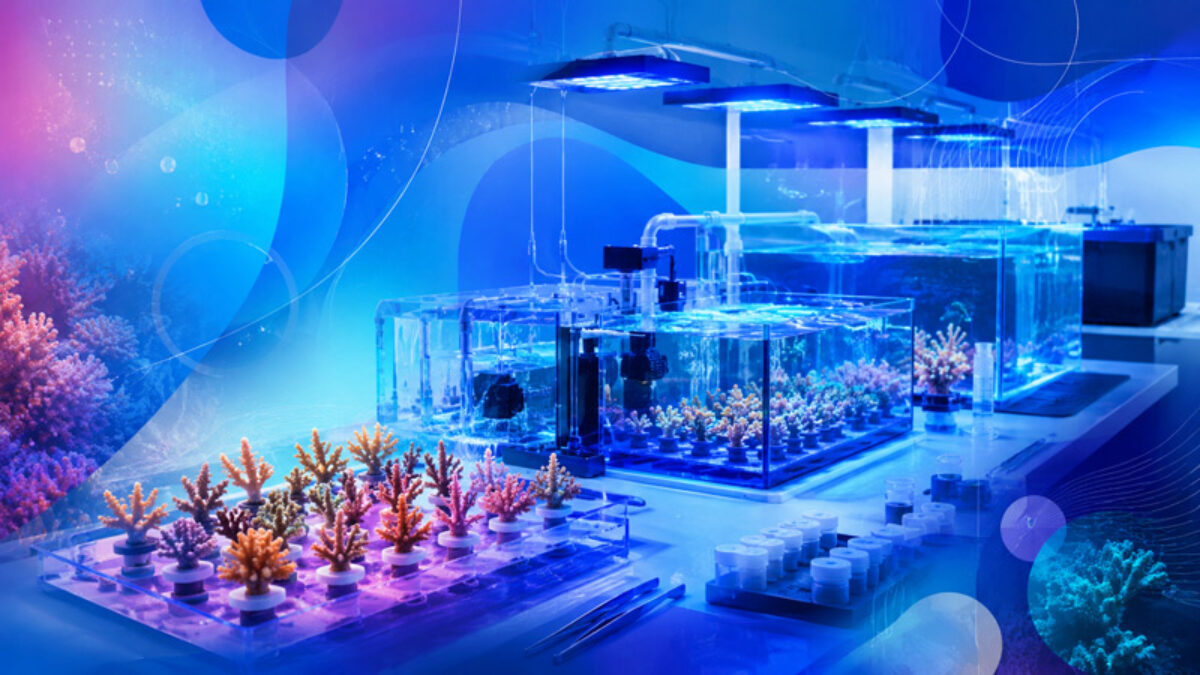
When Coral Futures Research and Innovation Centre launched in February 2026, we said something that not many early-stage nonprofits can say: the facility already exists. This post is a full account of what that means — what is physically in place, how each component works, and why we built it the way we did.
We believe in showing our work. So here it is.
Why We Built Before We Fundraised
The decision to build our research infrastructure before launching any public fundraising campaign was deliberate. It came from a conviction that credibility is demonstrated, not claimed. An organisation asking people to trust it with their money — and asking grant bodies to trust it with public funds — should be able to point to something real.
Our founding directors provided nearly £20,000 in personal zero-interest loans to make that possible. Those funds became the tanks, the filtration systems, the monitoring equipment and the operational infrastructure you will see described below. They are documented as formal liabilities in our accounts. No director receives interest, salary or expenses. The investment was made because the mission is genuine and because we wanted to earn the right to ask for support, not assume it.
What the Facility Contains
Acclimation and Quarantine System
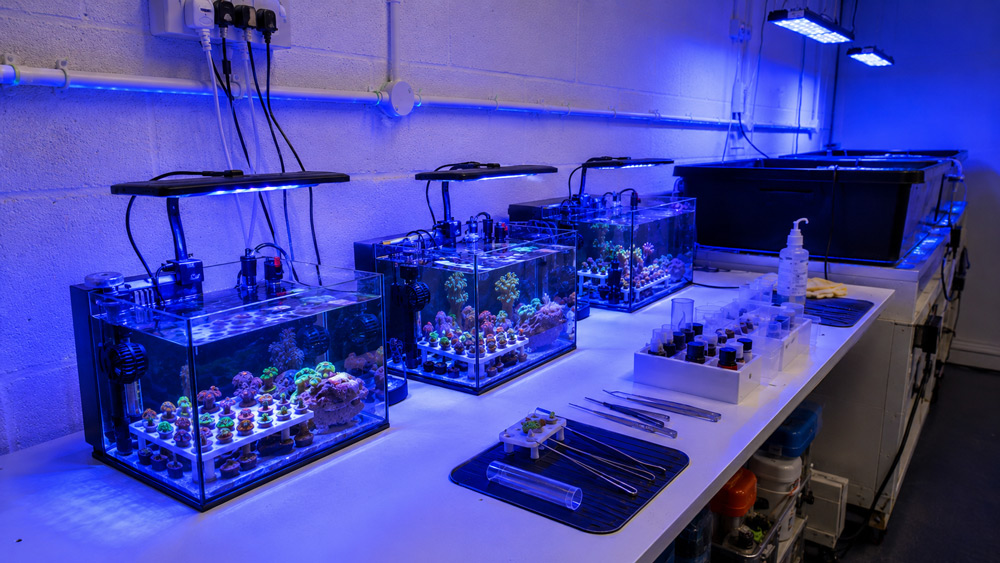
Before any coral specimen enters our propagation system, it passes through a dedicated acclimation and quarantine protocol. This is not optional and it is not administrative — it is fundamental to the integrity of our research.
Coral is a living animal. Introducing a new specimen directly into an established system without proper acclimation risks stress, disease transmission and compromised data. Our quarantine tanks provide a controlled transitional environment where new arrivals can be monitored, assessed and gradually adjusted to our water chemistry, temperature and lighting parameters before entering the main propagation system.
This approach reflects the care we take with every aspect of our work. If the science is going to be worth anything, the husbandry underpinning it has to be right.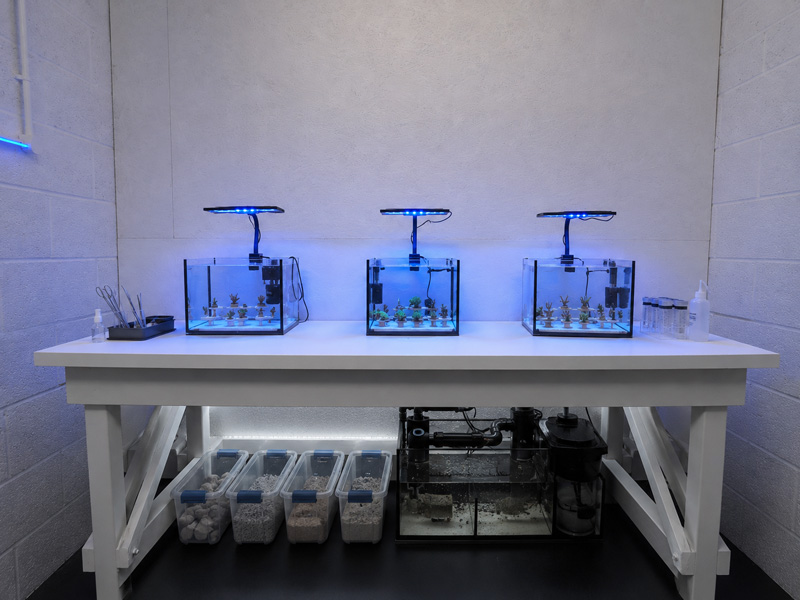
Propagation Tanks — Two Operational Systems
Our two operational propagation tanks are the heart of the facility. They house living coral colonies under continuously monitored conditions: temperature, salinity, pH, alkalinity, nutrients and flow rate are all tracked, recorded and responded to.
These tanks are where our primary research takes place. We observe coral behaviour under different conditions, test and document husbandry protocols, monitor growth and health indicators, and develop the methods that we intend to publish openly so that other practitioners can build on them.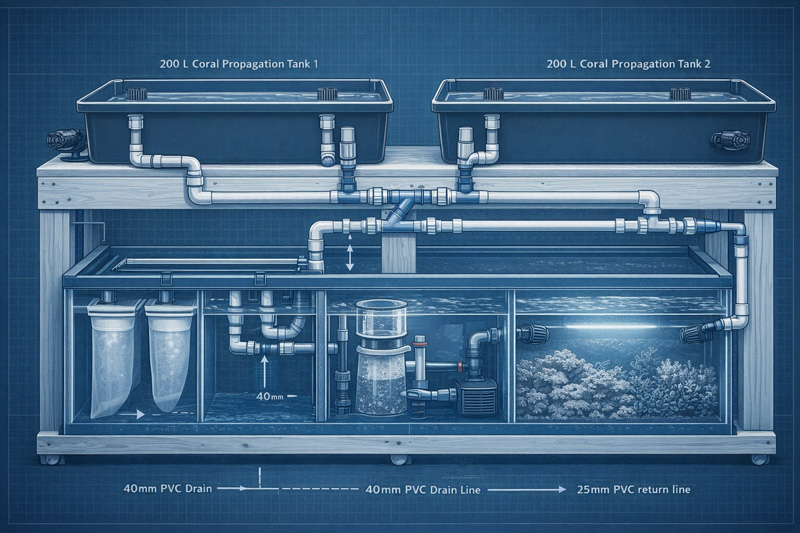
Deep-Water System — In Development
A third tank, requiring greater operational depth than our current propagation systems, is in active development. This will allow us to work with coral species and life stages that require different depth conditions — expanding both the range of species we can study and the scope of research questions we can investigate.
We include it here because being honest about what is in progress is as important as being specific about what is complete.
Monitoring and Environmental Control
The entire system is supported by continuous environmental monitoring. Every parameter that affects coral health is tracked, logged and responded to in real time. We do not rely on periodic manual testing alone. The monitoring infrastructure was part of the original build — not an afterthought — because we understood from the start that consistent, reliable data requires consistent, reliable environmental control.
Total system capacity: over 1,000 litres.
What We Are Researching
With the facility operational, our Phase 1 research focuses on the questions we can investigate with integrity at this stage.
- Acclimation protocols. How should coral be introduced to a new controlled environment responsibly and effectively? What parameters matter most, in what sequence, over what timescales? What does a healthy acclimation look like and how do we measure it reliably?
- Husbandry best practice. What water chemistry, lighting regimes, flow rates and care routines produce the best outcomes for the species in our collection? How do we detect and respond to early signs of stress before they become damage?
- Propagation methods. How do coral fragments respond to separation from parent colonies? What conditions promote healthy recovery and growth? How do we record and measure propagule health consistently?
Every protocol we develop is being documented in a format intended for open publication. We are not building proprietary knowledge. We are building a body of evidence that belongs to the wider conservation community.
What This Facility Is Not — and Why That Honesty Matters
We are not yet running field restoration programmes. We are not transplanting coral to degraded reefs. We are not operating at the scale of international research institutions with decades of expertise and established academic partnerships.
We say this clearly because the history of reef conservation includes projects that moved too quickly — organisations that made restoration claims before the underlying science was validated, scaled methods before they were proven, and announced impact before it was evidenced. Some of those projects caused harm. More of them simply did not work.
Our facility exists to build the knowledge base that makes conservation work genuinely effective. The research comes before the restoration claims. That is the correct sequence and we will follow it.
Support Our Research
Phase 1 funding is helping us complete the deep-water tank system, maintain our monitoring infrastructure and develop the open-access protocols that will make our research useful beyond Somerset.
30% of every Phase 1 donation is allocated directly to research infrastructure. Support our research →
If you have a background in marine science, ecology or coral biology and are interested in research collaboration or a facility visit, we would be delighted to hear from you. Contact us →

