Notice: Test mode is enabled. While in test mode no live donations are processed.
Coral Futures Research & Innovation Centre delivers free coral science and ocean literacy events directly to local schools and community venues across South Somerset. We go to where people already are. We bring the presenters, the materials and the coral specimens. Schools and community venues pay nothing. Participants pay nothing.
This is the programme that 60% of all Phase 1 donations fund.
If you are a teacher, school leader or community venue manager looking to book a free event, contact us directly at education@coralfuturesresearch.org. If you are assessing this programme for funding purposes, the sections below set out our aims, our community rationale and our intended outcomes in full.
Half the world’s coral reefs have already been lost to warming oceans, pollution and bleaching events. The other half face accelerating pressure. And yet, in most UK schools, there is no dedicated curriculum content on coral reef science — no lessons on how reefs function, why they matter or what is happening to them.
Most children in Somerset have never encountered a coral reef. Never seen living coral. Never understood why the ocean crisis connects to their lives and their futures. There is no specialist coral education facility open to schools and community groups in the South West. There are no regular coral science events in public venues in South Somerset. The gap between the urgency of the reef crisis and community understanding of it is vast.
Coral Futures is here to close it — beginning right here.
Our Phase 1 education and outreach programme delivers:
We measure the success of our education and outreach work against five clear outcomes.
Ocean literacy. Every pupil and community member we reach leaves with a working understanding of what coral reefs are, why they matter — even from landlocked Somerset — and what is happening to them globally. Standing in front of a living reef, close enough to observe it properly, makes that understanding stick in a way a textbook never can.
Connecting learning to action. Sessions don’t stop at facts. Seeing and engaging with living coral up close gives people a direct, personal connection to the reef crisis — and we build on that moment, linking it to real choices and actions, from our citizen science programme to everyday decisions that support ocean health.
Removing barriers. By bringing living coral reefs directly to schools, libraries and community venues — at no cost and fitted around existing timetables — we remove the cost, travel and access barriers that would otherwise make this kind of close encounter with a coral reef impossible for most people in our region.
Community ownership. We design our programme with input from the communities it serves, not in isolation from them. We consult teachers and community groups before we finalise session content. We adapt to what people need, not just what we want to deliver.
Open and replicable. Every session plan, resource and methodology we develop — including how we run mobile reef tank sessions safely and responsibly — is documented and intended for open sharing, so that what we build in Somerset can benefit any organisation delivering marine science education anywhere.
To book a free school or community event: education@coralfuturesresearch.org
Phase 1 education funding target: £10,800 (60% of Phase 1 total)
To support the full campaign: [Donate to Phase 1 →]
We don’t bring photos, videos or models of a coral reef into the classroom. We bring a coral reef.
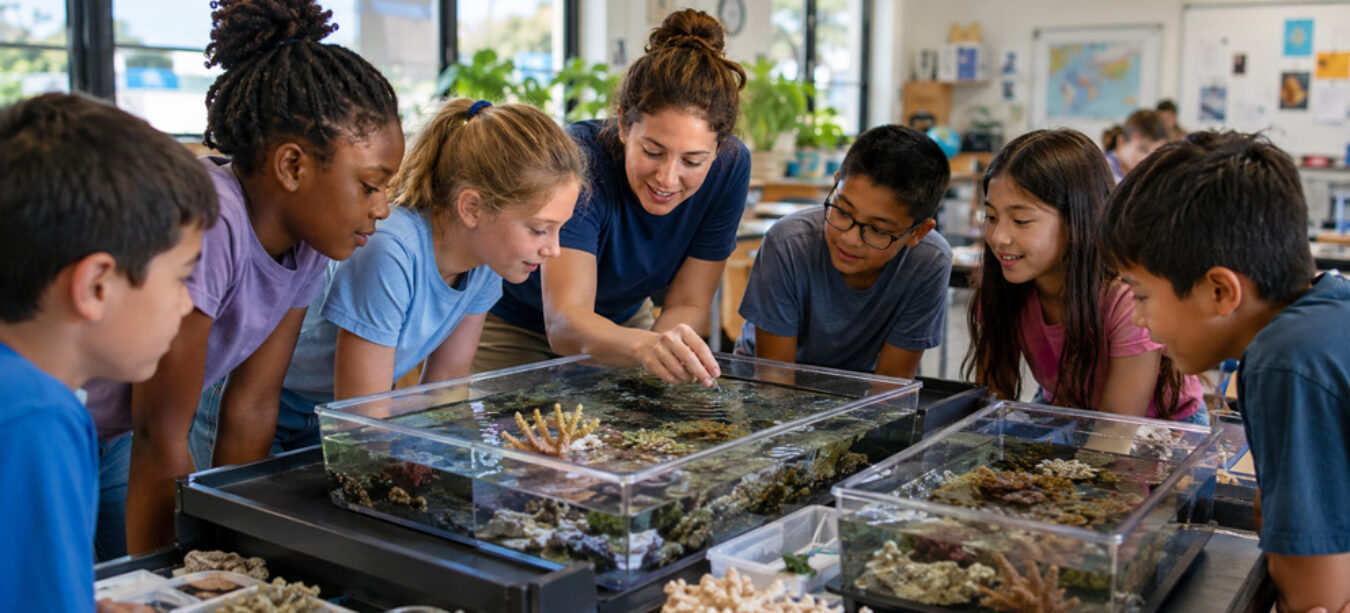
Using mobile reef tanks, we transport living coral directly to schools, libraries and community venues — giving pupils and visitors the chance to see, and get close to, a working reef ecosystem in person. For most students, this is the first time they will ever stand in front of living coral.
Each tank is built around its own theme and audience:
Symbiosis — what makes coral “alive,” and the partnership between coral and algae that builds entire reefs (Key Stage 1–2)
Biodiversity — a working reef ecosystem, and the species that depend on it (Key Stage 2–3)
Climate Change — what bleaching looks like, why it happens, and what it means for the future (Key Stage 3 and above)
Coral Propagation — a hands-on look at how new coral is grown from fragments, the same techniques used in our Somerset facility (Key Stage 3 / sixth form)
The tanks are sized and powered to travel — battery-run life support means we can set up in a school hall, library or community centre with no special infrastructure required, and pack down just as easily. Every coral travels under the same acclimation and welfare protocols we use in our research facility, because a classroom visit is still a research-grade environment for the animals in our care.
Close-up viewing, guided observation and direct interaction with the tanks are at the heart of every session — turning “the ocean is in crisis” from something pupils read about into something they’ve stood in front of.
To book a free school or community event: education@coralfuturesresearch.org
Phase 1 education funding target: £10,800 (60% of Phase 1 total)
To support the full campaign: [Donate to Phase 1 →]
Notice: Test mode is enabled. While in test mode no live donations are processed.